Client Relationship Management for Professional Services Firms
Professional services firms win work through relationships. Here is how accountants, solicitors, brokers, advisers and recruiters can manage them properly.
In professional services, you are not selling a product. You are selling expertise and trust. Clients choose an accountant, solicitor, broker or adviser because of a relationship, and they stay, or leave, for the same reason.
Yet many firms manage their most valuable relationships through a mix of personal inboxes, partners’ memories and a spreadsheet nobody updates. When a fee-earner leaves, the relationships often leave with them.
Client relationship management is the discipline of looking after those relationships deliberately. Here is how to do it well.
Why it matters more in professional services
- Work is recurring. Year-end accounts, annual reviews, insurance renewals and repeat hires all depend on staying front of mind.
- Referrals drive growth. Most new clients come from existing clients and introducers.
- Relationships are spread across the firm. A client may deal with a partner, a manager and an administrator.
- Cross-selling is natural. A conveyancing client may need a will; a payroll client may need advisory work.
Practice software vs a CRM
Most firms already have practice, case-management, broking, applicant tracking or property software. That system is where the regulated work lives: matters, policies, files, compliance records and billing.
A CRM does a different job. It handles the relationship and business-development side: prospects who are not clients yet, introducers, conversations, follow-ups, renewals and opportunities. The two work best side by side, with the CRM as the place your whole team sees who you know and what happens next.
7 habits of firms with strong client relationships
- One shared record per client. Every contact at the client, every conversation and every key document in one place, not in individual inboxes.
- Log significant conversations. A two-line note after a call means anyone in the firm can pick up the thread.
- Diarise the key dates. Year-ends, renewals, reviews, contract end dates and anniversaries, with reminders weeks ahead.
- Proactive check-ins. Contact clients when there is a reason: a rule change, a deadline, a useful idea. Not only when you need something.
- Look after introducers. Track who refers work to you, and thank and refer back where you can.
- Track opportunities. Record new instructions and cross-sell opportunities as deals with a value and a next step.
- Plan for people leaving. If the relationship history lives in the firm’s CRM, a departing fee-earner does not take it with them.
What it looks like by profession
- Accountants: track year-ends, tax deadlines and advisory opportunities. See CRM for accountants.
- Law firms: keep referrers, prospects and past clients in touch for future instructions. See CRM for law firms.
- Insurance brokers: never miss a renewal conversation. See CRM for insurance brokers.
- Financial advisers: schedule annual reviews and follow up introductions. See CRM for financial advisers.
- Recruitment agencies: manage client companies and hiring managers alongside your ATS. See CRM for recruitment agencies.
- Estate agents: follow up valuations and keep landlords and vendors warm. See CRM for estate agents.
- IT and management consultancies: track proposals, contract renewals and account growth. See CRM for IT consultancies.
Data protection
Client and prospect data is personal data under UK GDPR. Keep only what you need, keep it accurate, restrict who can see it and know how long you will keep it. A shared CRM with user roles is far easier to control than copies of spreadsheets on several laptops.
How Bizora helps
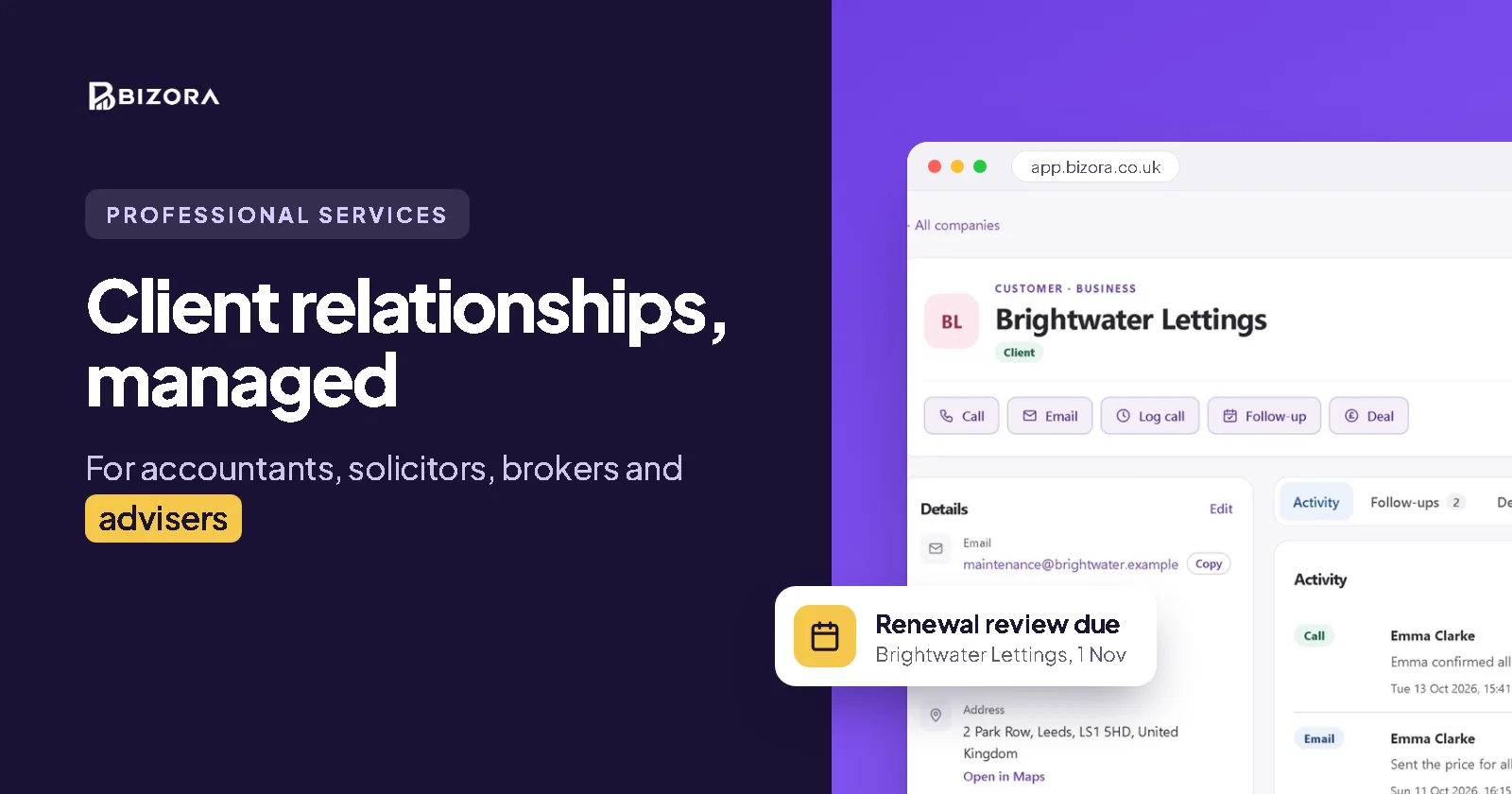
Bizora is a simple CRM for firms that sell expertise. Each client is a company with its contacts, logged calls, emails and meetings, documents, deals and dated follow-ups on one record. Custom fields hold details like renewal dates or year-ends, the calendar shows them alongside meetings, and team permissions control who can do what. It works for a sole practitioner or a firm of up to 500 people.
Read our overview of CRM for professional services, or start free and upgrade when your team needs more room.
Common questions
What is client relationship management?
It is the practice of managing your relationships with clients and prospects deliberately: recording conversations, keeping in touch at the right times and tracking new opportunities.
Do professional services firms need a CRM if they have practice management software?
Often, yes. Practice software runs the client work and compliance. A CRM handles prospects, introducers, conversations, follow-ups and new business, alongside it.
How do I stop client relationships leaving with a fee-earner?
Keep contacts, conversation notes and follow-ups in a shared firm CRM rather than personal inboxes, so the history stays with the firm.
What should a professional services firm track in a CRM?
Clients, contacts, introducers, key dates such as renewals and year-ends, logged conversations, documents and opportunities for new work.