Sales Pipeline Stages for Small Businesses: A Simple 5-Step Pipeline
A sales pipeline does not need to be complicated. Here is a simple five-stage pipeline that suits sole traders and SMEs, what each stage means and how to keep deals moving.
"Sales pipeline" sounds like something for big sales teams. In reality, every business that sends quotes already has one. It is just usually kept in someone’s head. Writing it down makes it far easier to see what work is coming, and what is about to slip away.
What is a sales pipeline?
A sales pipeline is the set of steps a potential customer goes through, from first enquiry to paying customer. Each open deal sits at one stage. Looking at the whole pipeline tells you how much work is in play and where things are getting stuck.
A simple five-stage pipeline
Most small businesses only need five stages:
- Enquiry. Someone has asked about your services. Capture their details and what they need.
- Visit or call booked. You have arranged to see the job or talk it through.
- Quote sent. The customer has your price and is deciding.
- Won. They said yes. The deal leaves the pipeline and becomes work.
- Lost. They said no, went quiet for good or chose someone else. Note why, if you know.
You can rename the stages to suit your business. A consultant might use Discovery call, Proposal sent and Negotiating. An agency might add Brief received.
How to move deals through the pipeline
- Give every deal a value. Even a rough figure lets you add up what is in the pipeline.
- Give every deal a next step and a date. A deal without a next step is a deal that is drifting.
- Follow up at each stage. Most deals stall at Quote sent. A friendly chase a few days later wins many of them. See how to follow up a quote.
- Close deals honestly. Mark them won or lost rather than leaving them open forever. A pipeline full of dead deals tells you nothing.
What to measure
A few simple numbers tell you a lot:
- Pipeline value: the total value of open deals. Is there enough work coming?
- Win rate: the share of quotes you win. A low rate may point to pricing or follow-up.
- Average deal value: the typical size of a won job.
- Time to win: how long deals take from enquiry to yes.
- Why deals are lost: price, timing or something else.
Common pipeline mistakes
- Too many stages, so nobody keeps them up to date
- Deals with no value or next step
- Never marking deals lost
- Only looking at the pipeline when work dries up
Keep your pipeline in one place
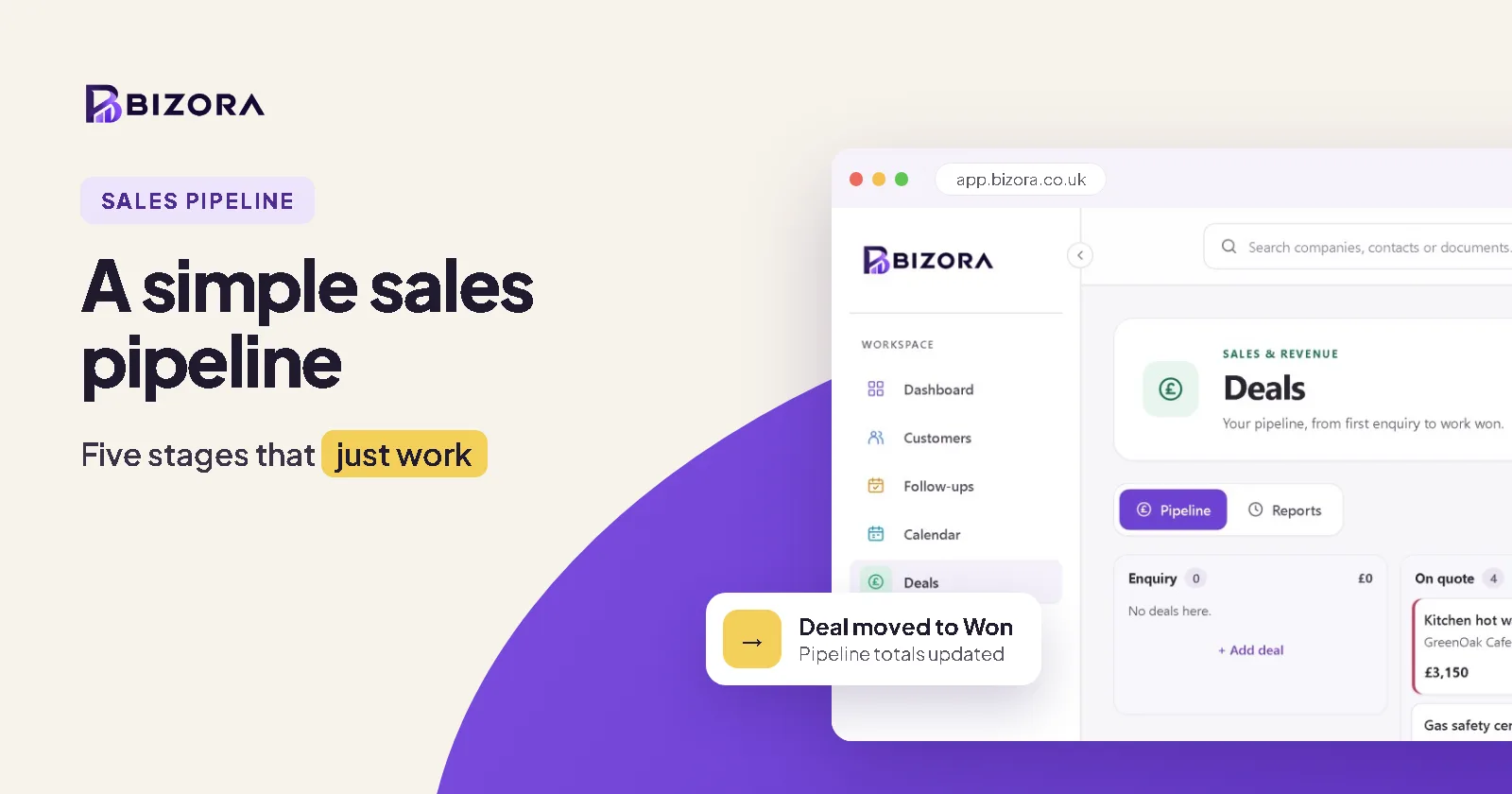
A whiteboard or spreadsheet can work for a handful of deals, but they will not remind you to chase. In Bizora, your pipeline is a simple board: drag deals between your own stages, see the total value of each column, and get a reminder to chase quotes automatically. Reports show your win rate, money won and best customers. See deal tracking.
Common questions
What are the stages of a sales pipeline?
For most small businesses: enquiry, visit or call booked, quote sent, won and lost. You can rename them to suit your work.
How many stages should a sales pipeline have?
As few as possible. Three to six is plenty for most small businesses.
What is the difference between a pipeline and a funnel?
They describe the same journey. A pipeline focuses on the deals at each stage; a funnel focuses on how many drop out along the way.
Do I need software for a sales pipeline?
Not at first, but software reminds you to follow up and adds up the numbers for you, which is where most of the value is.